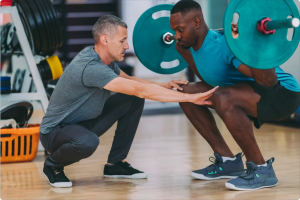
 Regardless of the sport you play, strength training should be a part of your sports performance training routine. Though the sport and position you play can affect the type and frequency of strength training, most athletes can benefit from following a few foundational athletic performance training tips. Before you hit the weight room, take a moment to check out some strength training tips for each major sport.
Baseball Strength Training Tips
Strength training for baseball players should focus primarily on increasing throwing velocity, arm strength, bat speed, and agility. Review our top tips for building your strength in a way that focuses on the most important attributes of baseball:
- Don’t neglect your lower body: While you might think you need to focus on your upper body to throw and hit harder, your lower body is actually incredibly important to both. Since you need your lower body to generate energy and power while throwing and hitting, performing lower-body strength training exercises can be very beneficial. Some common workouts for building your lower-body strength for baseball include lunges, leg cradles, barbell squats, goblet squats, and lateral bounds.
- Train your upper back: When you throw a baseball, your upper back helps decelerate your arm to protect it from injury and ensures your shoulder joint can rotate properly without putting stress on your elbow. Strength training exercises that target the upper back, such as bent-over rows, single-arm rows, TRX suspension rows, and seated cable rows, can assist with injury prevention.
Basketball Strength Training Tips
While cardio is the most important for basketball players, they can still benefit from strength training. Below, you can find a few quick tips to improve your basketball strength training routine:
- Build your explosive power: Whether you’re leaping to block a shot or blowing by a defender with a strong first step, explosive power is a must, as it helps you jump higher and move faster. Some common exercises that target explosive strength include jump squats, split squats, trap bar deadlifts, kettlebell swings, and power cleans.
- Vary your training based on position: If you’re a guard, you shouldn’t train like a power forward or center. For example, guards tend to need to train agility and speed, while a forward or center will want extra strength and bulk to hold their own in the post. As a result, guards will want to stick to heavy weights with low reps and long rest periods. In contrast, forwards and centers should perform more reps and have shorter rest periods between sets.
Football Strength Training Tips
Football players have to focus on building their strength to ensure they don’t get pushed around on the field. While a lineman’s training routine will be different than a receiver, the following tips are great for football players looking to improve their general strength:
- Focus on your core stability: During a football game, players have to quickly change direction and twist around while tracking the ball or running routes. Focusing on your core stability can reduce stress on your core muscles and make you more formidable on the field. Popular core exercises include lunges, farmer’s walks, and body-weight exercises, like planks.
- Incorporate grip strength workouts: A high grip strength can help football players tackle opposing players, keep hold of the ball, and better direct their throws. Some exercises to increase grip strength include pull-ups, rows, and farmer’s walks.
- Include explosive power exercises: Like in basketball, explosive power is essential for football players, as it helps you tackle harder and run faster. If you want to increase your explosive power, add overhead presses, calf raises, and squats to your routine.
Soccer Strength Training Tips
Though running speed and endurance are key for soccer players, strength training is essential for soccer players to improve their balance, increase their kicking strength, and reduce their risk of injury. If you want to incorporate some soccer strength training exercises into your routine, review our tips below:
- Perform functional movement to reduce injury: Soccer players can reduce their risk of injury by adding functional movements to their workout routine. For example, deadlifts and squats can help strengthen lower body muscles responsible for stabilizing hip and knee joints.
- Train your arms and shoulders: Though lower body workouts will be the bulk of your strength training regimen for soccer, don’t neglect your upper body. Performing dumbbell presses, shoulder presses, and other upper body exercises can help prepare you for contact with other players and improve your physicality.
- Incorporate strength exercises that target your lower body and core: A strong core helps you stabilize your body and change directions quickly. As you work on your lower body strength, include exercises that also include your core to receive the benefits of both. Some soccer strength training exercises that target your core and lower body include kettlebell swings, dumbbell lateral lunges, and goblet squats.
Volleyball Strength Training Tips
While training for volleyball, strength exercises can assist with increasing explosiveness, reducing the risk of injury, and improving overall coordination. Some ways you can receive these strength training benefits for volleyball players include:
- Spend time strengthening your lower body: Your lower body strength will directly impact how high you can jump and your overall explosiveness. Common lower-body strength exercises for volleyball include forward lunges, hang cleans, barbell squats, and box jumps.
- Incorporate upper body exercises for greater control and hitting power: While lower body strength exercises give you the power you need to jump high, you need to be able to control where you hit the ball while maintaining your strength and speed. Upper body exercises, like military presses, overhead presses, and push-ups, can improve your overall stability and power while leaping.
Combat Strength Training Tips
In a combat sport, you don’t have to be stronger than your opponent to win, but it can certainly help. Though you shouldn’t try to get bulky, strength training can assist with your explosive power and stability in the ring. Review a couple of quick tips for combat strength training below:
- Strengthen your core: Maintaining your stability during a combat sport can set you apart from your opponent, and you need a strong core to remain stable while in combat. Since your stability and rotational power will affect the effectiveness of your striking movements, make sure to perform lunges, deadlifts, and bridges for greater stability. If you want to improve your rotational power, exercises like landmine twists, Russian twists, rotational lunges, wood chops, and rotational wall slams can all be helpful.
- Avoid training with low-repetition sets: As a combat sports athlete, your conditioning and skill work are far more important than your maximum strength. As a result, you shouldn’t prioritize training to the point of failure with few reps during lower or upper-body workouts. Instead, focus on improving your strength through higher repetitions, as this approach can ensure you can give it your all during conditioning and skill sessions.
Take Your Athletic Performance Training to the Next Level With Chain Effect
Alongside following the tips above, we recommend scheduling an appointment with a personal trainer in your area to help you build a workout plan with sport-specific exercises. By working with a personal trainer who has experience in your sport, you can optimize your strength training routine for your position. Working with a physical therapist can also help you recover from injuries and prevent them from occurring in the future.
If you live in or around Raleigh, NC, your first personal training session at Chain Effect is free–so reach out today.
Have questions? Looking to schedule an appointment? Contact us below.