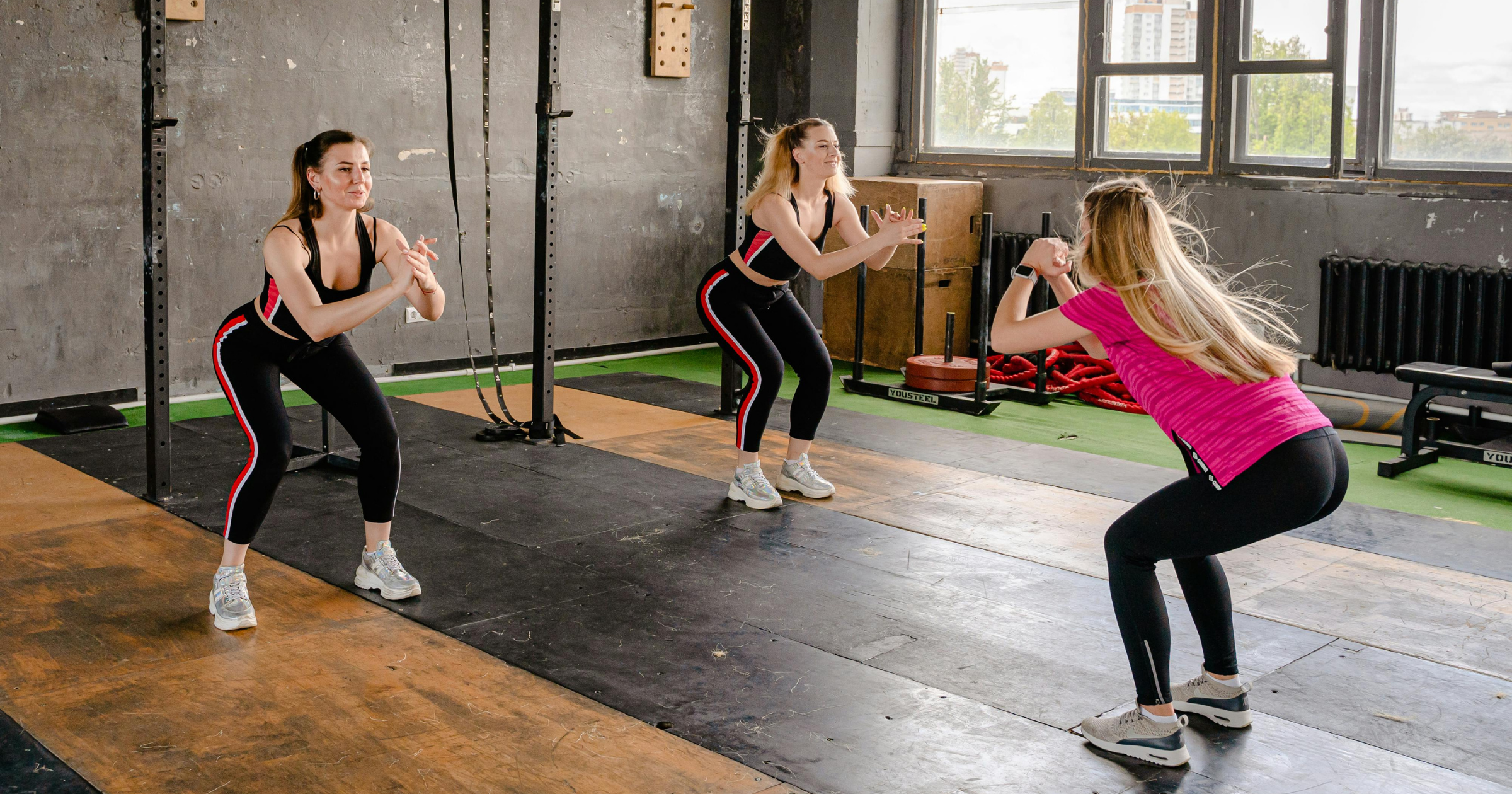
What the latest Chain Effect Podcast taught us about moving and training better.
If your Instagram feed has you convinced that squats are just about booty gains…you’re not totally wrong. But they’re also about way more than aesthetics. A great squat isn’t just a “look,” it’s a measure of how well your body moves and functions. It’s a snapshot of your body’s strength, mobility, and motor control, and getting it right pays dividends for sports performance, injury prevention, and everyday life (think: getting off the floor, in and out of cars, playing with your kids).
This week’s Chain Effect Podcast episode, “Drop It Like A Squat,” dives into everything you need to know about squats. Taylor Pope, DPT, and Caroline Pope, RD, break down what a deep squat is, why “butt wink squats” happen, and how to personalize your depth without wrecking your knees or back.
Below is your friendly, practical recap, plus simple screens and drills you can use this week.
Listen to the episode: Drop It Like A Squat
Everything You Need to Know About Squats
Why Squats Matter (even if you’re not a powerlifter)
Squats aren’t just for the gym; they’re a foundation for life.
- They’re a full-body check-in. A deep squat asks for ankle mobility, hip mobility, thoracic mobility, and core control all at once.
- They transfer to real life. From stairs to sport to “I dropped my phone under the couch,” squatting well keeps you capable.
- They’re a longevity play. Strong quads/glutes + confident up-and-down mechanics = independence as we age.
- They’re a performance booster. Full-range squats build strength at long muscle lengths, setting you up for faster cuts, stronger jumps, and better acceleration.
Deep Squat vs. Partial Squat: Which Depth is “Right”?
Here’s the short answer: the best depth is the one you can own with control.
Full-Depth Squats (Below Parallel)
Pros
- More muscle activation at long lengths → powerful hypertrophy signal for quads & glutes
- Bigger mobility dividend for hips/ankles
- Strong carryover to athletic positions (think: cutting, jumping, sprint start mechanics)
Considerations
- Knee caps (patellofemoral joint) see higher stress at deep angles, so alignment matters.
- Requires solid ankle dorsiflexion, hip internal rotation and flexion, and spinal control
- If you’ve got cranky knees or hip impingement, you’ll need a plan before going deep
Partial-Depth Squats (To ~90° or Above)
Pros
- Let’s you train heavier safely while you build mobility/control
- Often friendlier on irritated knees/hips in the short term
- Great bridge while you work toward deeper ranges
Considerations
- Less total hypertrophy stimulus for some tissues
- Slightly less sport-specific carryover than full range
Chain Effect’s Personal Training Take: Many lifters do both weekly: partials for top-end strength + full range for mobility and “lengthened-position” strength.
Learn more squat techniques here.
The “Butt Wink Squat,” Explained
A butt wink happens when the pelvis tucks under at the bottom of a squat.
A slight tilt is common, especially as you approach end range. The red flag is when this tilt is paired with low-back rounding under heavy load. That combo can increase shear stress on your spine.
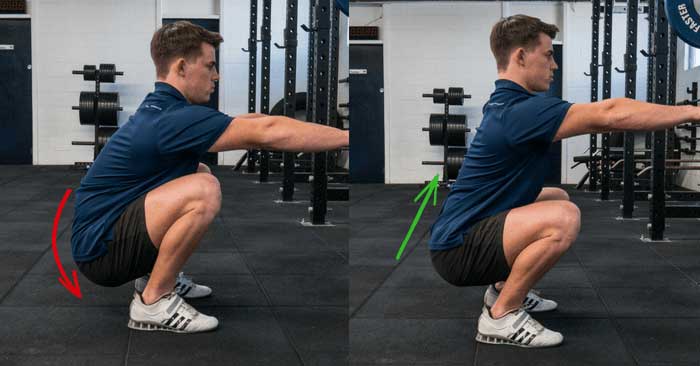
Image courtesy of Movement Enhanced.
To reduce butt wink:
- Improve hip flexion and hamstring length
- Earn more ankle dorsiflexion so the shins can travel forward
- Train lumbopelvic dissociation (keep the spine quiet while the hips move)
Choose the depth you control, then build from there
Quick Squat Self-Screens You Can Do to Ensure Squat Form
1. Wall Ankle Test (Dorsiflexion)
Stand facing a wall, with your foot ~4–5 inches back. Can you touch your knee to the wall without the heel lifting? No? Your ankles may be capping your depth.
2. Overhead Bodyweight Squat (filmed from the side)
Hands overhead, feet hip-width, slow squat. Ask yourself the following questions:
- Do the arms stay mostly overhead?
- Do the knees track over the middle toes (not caving)?
- Does the torso and shin angle look roughly parallel at depth?
- Do you see a big low-back round at the bottom (a sign of instability)?
3. Single-Leg Sit-to-Stand
From a chair, stand up using one leg (control down, too). Noting side-to-side differences flags where to focus strength.
Simple Mobility & Activation Prep (5–8 minutes before squatting)
Do these before your workout for better form and mobility:
- Ankles: 10–15 rocking knee-to-wall reps/side
- Hips: 8–10 90/90 switches + 8–10 hip airplanes/side
- Core/torso: 2×20–30s tall-kneeling band pulldowns (ribs down)
- Patterning: 2×6–8 goblet “counterbalance” squats (hold a plate out as you descend to help you own deeper positions)
Bonus Tip: If you tip backward in deep bodyweight squats, try heel wedges or weightlifting shoes while you build ankle range.
Don’t forget to warm up before these exercises! Warmups also matter; see why here.
A Smart Weekly Squat Blend:
- Day 1: Strength & depth
- Front Squat: 4×4–6 @ moderate load you can control below parallel
- Split Squat (rear foot elevated): 3×8/side
- Core: 3×8 tempo dead bug (3s lower)
- Day 2: Overload without cranky joints
- Back Squat to Box (just above parallel): 5×3 heavy with pristine form
- Romanian Deadlift: 3×6–8
- Land & Stick Jumps: 3×5, focusing on knees tracking over toes
- Day 3: Accessories & resilience
- Goblet Cyclist Squat (heels elevated): 3×10–12
- Hip Thrust or Bridge: 3×8–12
- Sled Push/Pull: 4–6 medium pushes (low back friendly conditioning)

When to Ask a Chain Effect Pro for Help
If you notice:
- Knees cave in at the bottom or on the way up
- Pinchy front-hip feeling at depth
- Persistent knee pain near the kneecap after squatting
- Low-back rounding that won’t improve despite mobility work
These are all solvable issues! You just need the right eyes on your movement and a tailored plan.
How Chain Effect Helps You Squat Better
At Chain Effect in Raleigh, we bring personal training, active recovery, and physical therapy under one roof so your squat (and the rest of your training) can actually move forward safely.
- Chain Effect Personal Training:
One-on-one coaching that blends strength science with your real life. We screen your movement, dial in stance, bar position, and depth for your structure, then progress load and volume with intention. You’ll leave each session knowing what to do and why it works. - Physical Therapy (Performance PT):
If pain or a past injury is holding you back, our DPTs assess hips/ankles/spines, clean up mechanics (hello, butt wink), and treat what’s limiting you so you can train, not tiptoe around issues. - Active Recovery in Raleigh:
Are you sore after front squats? Use our recovery tools (Nucalm Stress Management and NormaTec) to bounce back faster and maintain momentum. Consistency is the secret sauce.
Ready to Make Your Squat a Superpower?
Whether you’re chasing a deeper front squat, rehabbing a cranky knee, or just want to move like an athlete again, the Chain Effect team meets you where you are and builds from there. No cookie-cutter programs. No ego lifting. Just thoughtful coaching, smart progressions, and a recovery plan that keeps you in the game.
Book a personal training session at Chain Effect (Raleigh, NC) and let’s turn your squat into a strength you can rely on, on the platform, on the field, and in everyday life. And if something’s talking back (hip, knee, or low back), start with Physical Therapy and slide seamlessly into training once you’re ready. Your future self (running, lifting, playing) will thank you.
Bonus Tip: If you’ve got the squat down but still aren’t meeting your fitness goals or body gains, maybe it’s time to ask a registered dietitian. Check out Chain Effect’s nutrition counseling here.