

Raleigh, NC · What we treat
Shoulder pain in Raleigh.
A shoulder that’s stiffened up, or a lift that’s started to catch: a cause-first evaluation finds why your shoulder is doing this, then a personalized plan gets you reaching overhead, sleeping on that side, and lifting without the wince first.
You’ve probably said one of these.
Nobody walks in describing a rotator cuff tear they haven’t had imaged. They describe days like these. Tap one that sounds like your week.
-
UsuallyRotator cuff irritation or shoulder impingement, strength that backs off before the pain ever gets loud.
See how physical therapy rebuilds the load ⟶ -
OftenTendon irritation or early stiffness, worse at night because the joint has nowhere neutral to rest.
See how manual therapy and dry needling calm it down ⟶ -
UsuallyA mechanical pinch, tissue caught between the shoulder blade and the arm bone in a specific range of motion.
See how personal training builds the range for good ⟶
- “Putting on a jacket, I do the bad arm first now, or it doesn’t go on at all.”
- “I let it hang at my side on the stairs instead of using the rail.”
- “Washing my hair, my arm gives out before my hair does.”
If two or three of those sound like your week, you’re not describing a mystery. You’re describing a pattern we see often, and one an evaluation is built to explain.
Why does shoulder pain happen?
There’s rarely one single cause, which is exactly why guessing doesn’t work. What we usually find, alone or in combination:
- Rotator cuff irritation or tendinopathy. The tendons stabilizing the shoulder’s ball and socket, often irritated by repetitive overhead motion or lost strength.
- Shoulder impingement. Tissue pinched between the top of the arm bone and the bone above it, often during reaching or lifting overhead.
- Frozen shoulder. A shoulder capsule that’s tightened and lost range, often for reasons that aren’t fully clear, tending to move through predictable stages.
- Labral irritation. The cartilage ring that stabilizes the joint, sometimes irritated by overhead sports or a specific injury.
- Overuse in throwing or lifting. Repeated load, from a sport, a job, or the gym, that’s outpaced the shoulder’s capacity to recover between sessions.
None of these are diagnoses you make yourself, and most don’t require imaging to start treating. That’s what the evaluation sorts out.
How do we treat shoulder pain in Raleigh?
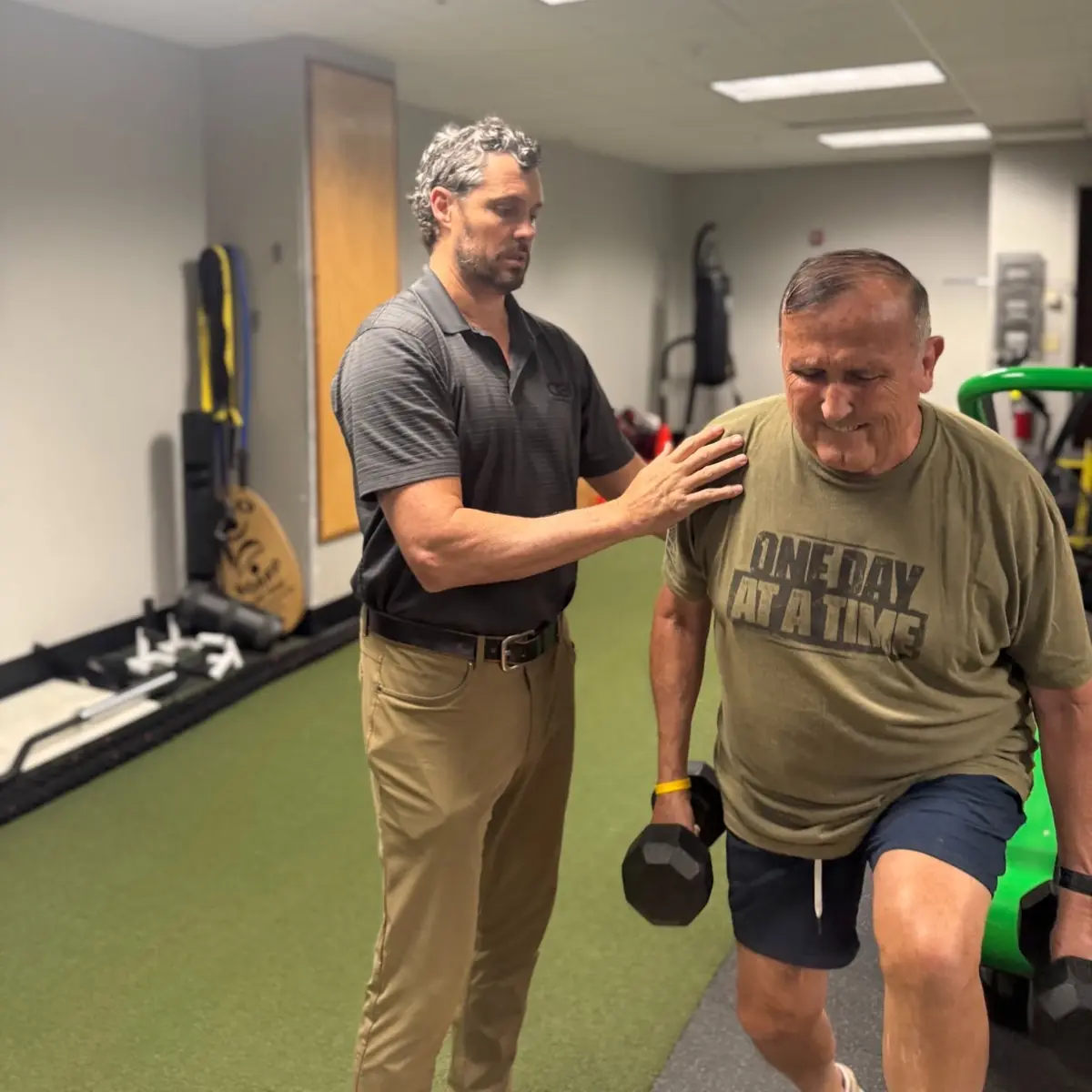
Treatment starts with a cause-first evaluation: testing how your shoulder blade, neck, and shoulder joint move and load together, because a shoulder that hurts on lifting doesn’t always fail at the shoulder itself. From there, every visit is one-on-one with the same Doctor of Physical Therapy, blending hands-on treatment with strength work in our gym.
We stay with you until your goals are met, not until your benefits run out. There’s no early discharge: you decide when you’re ready.
Calm it down.
Hands-on manual therapy and positions that unload the irritated tendon or joint, starting the first visit. Most patients notice a difference within the first few sessions.
Restore what’s stuck.
Mobility work for the shoulder blade and joint capsule actually restricting you, dosed to what the shoulder can tolerate that week.
Build strength you trust.
Progressive rotator cuff and shoulder-blade strength against standards you clear before moving on, so overhead reaching becomes load-tolerant again, not just pain-free.
Make it stay fixed.
Testing before you’re cleared, then a home program sized to your sport, job, or gym routine, plus coaching on the mechanics that tend to reload the same tendon.
What does getting better look like?
People who end up booking an evaluation for shoulder pain are rarely the ones who tore something in a single dramatic lift. More often, it’s a slower story: months of quietly favoring the other arm, skipping the exercises that require reaching overhead, assuming a stiff shoulder is just part of getting older. If that’s closer to your version, you’re the typical patient here, not an outlier.
Most patients notice a difference within the first two or three visits, since hands-on treatment starts at the evaluation itself. Progress tends to show up in ordinary places first: reaching the top shelf without switching arms, sleeping through the night on either side, lifting something off a car seat without bracing first. Left untreated, the cause rarely stays quiet; it tends to change how you reach, lift, and sleep, and each flare tends to run a little longer than the last.
An evaluation turns that guesswork into a plan with a specific estimate, reviewed with you as you progress.
Which services treat shoulder pain?
Physical Therapy
The foundation: 60-minute one-on-one sessions with a Doctor of Physical Therapy, hands-on from day one.
02Sports Rehab
Return to throwing, lifting, and overhead sport.
03Dry Needling
Releases the guarding around the shoulder blade and rotator cuff.
04Manual Therapy
Hands-on mobilization for a stiff or frozen shoulder.
05Personal Training
Builds the overhead strength that keeps a healed shoulder from becoming a repeat visitor.
“I have been suffering from frozen shoulder for the last four years and have tried multiple physiotherapists, doctors, massage and acupuncture but nothing worked. I had lost almost half the mobility in my left arm and was desperate for help.I am so grateful I found ChainEffect and was assigned to Taylor. Within just one month I have regained about 50% of my mobility, which feels like nothing short of a miracle.Taylor has been incredibly patient throughout, trying different approaches to address both my pain and mobility. He always explains what he is going to do before each session and is extremely knowledgeable. I cannot recommend him highly enough.”Priyanka Banerjee · Google review
Questions, answered plainly.
The things people ask on the phone about their shoulder, written down.
It might be, but tear is not something to diagnose from home, and plenty of shoulder pain comes from irritation or impingement without any tear at all. The evaluation tests strength, motion, and the specific movements that reproduce your pain, which usually points to the cause without needing imaging first. If something looks like it needs an MRI or a physician’s opinion, we’ll say so and point you there directly.
Usually not. Most shoulder pain can be evaluated and treated based on movement, strength, and provocation testing, without imaging, and treatment often starts making a difference before a scan would even be scheduled. If your exam findings suggest something imaging should confirm, we’ll refer you for that directly.
Often, yes, with modifications specific to your sport or training. Most shoulder plans scale certain movements or ranges back for a while rather than stopping activity altogether, then reintroduce them once you have cleared the standard. Athletes and lifters typically get a specific return-to-load plan rather than a blanket rest order.
Avoid pushing through a sharp or catching pain, sleeping in a position that pins the shoulder underneath you, and sudden heavy overhead lifting before you have been cleared. Beyond that, complete rest is rarely the fix: most people do better learning which ranges are safe to load than by keeping the arm still and waiting. Your evaluation will tell you exactly what to modify.
Start with a cause-first evaluation for your shoulder.
Gameplan with an expert.
A few short questions. Our client matchmaker reaches out to learn about your pain, challenges, and goals, and connects you with the right expert.
If you’re in acute pain and want to be seen the next morning, tell us in your message and we’ll do our best to get you in as soon as possible.
Here we go.
Our client matchmaker will reach out as soon as possible. During business hours, Mon–Thu 8–5 and Fri 8–4, we strive to get in touch within 15 minutes.
Can’t wait? Call (919) 594-1885 ⟶Find us on Blue Ridge Road.
Rehab, training, and nutrition under one roof in Raleigh, with virtual nutrition counseling for clients anywhere.
The clinic · Chain Effect Physical Therapy
Get Directions ⟶Opens in Google Maps