

Raleigh, NC · What we treat
Knee pain in Raleigh.
An ache that votes against every set of stairs and every squat rarely has one clean cause: a cause-first evaluation finds out why your knee is doing this, then a personalized plan gets you back to running, kneeling, and standing up without the wince first.
You’ve probably said one of these.
Nobody walks in describing patellofemoral pain. They describe mornings like these. Tap one that sounds like your week.
-
UsuallyRunner’s knee, irritation around the kneecap that flares more with descending than with climbing.
Why does this happen ⟶ -
UsuallyDeconditioning or joint wear, quads that have lost the strength to stand you up without help from your hands.
Why does this happen ⟶ -
UsuallyMeniscus irritation or joint wear, catching or aching under the direct load kneeling puts on the joint.
Why does this happen ⟶
- “I used to run three miles without thinking. Now I’m rationing which days I run at all.”
- “Turning to grab something behind me, my knee gives this little catch.”
- “I ice it after every walk longer than a mile, just to be safe.”
If two or three of those sound like your week, you’re not describing a mystery. You’re describing a pattern we see often, and one an evaluation is built to explain.
Why does knee pain happen?
There’s rarely one single cause, which is exactly why guessing doesn’t work. What we usually find, alone or in combination:
- Runner’s knee. Irritation around or under the kneecap, tending to flare with stairs, squats, and downhill walking or running.
- Ligament sprain or post-surgical recovery. An ACL, MCL, or similar ligament that’s been overloaded or reconstructed, often leaving the knee feeling unstable or guarded on turns.
- Meniscus irritation. The knee’s cartilage cushion catching or aching, often after a twist, a deep squat, or simply years of load.
- Joint wear. Gradual change in the knee joint’s cartilage, often showing up as stiffness after sitting or a dull ache that builds through the day.
- Deconditioning. Quads and hips that have quietly lost strength, often after months of less activity than usual, leaving the knee to absorb load it isn’t ready for.
None of these are diagnoses you make yourself, and most don’t require imaging to start treating. That’s what the evaluation sorts out.
How do we treat knee pain in Raleigh?
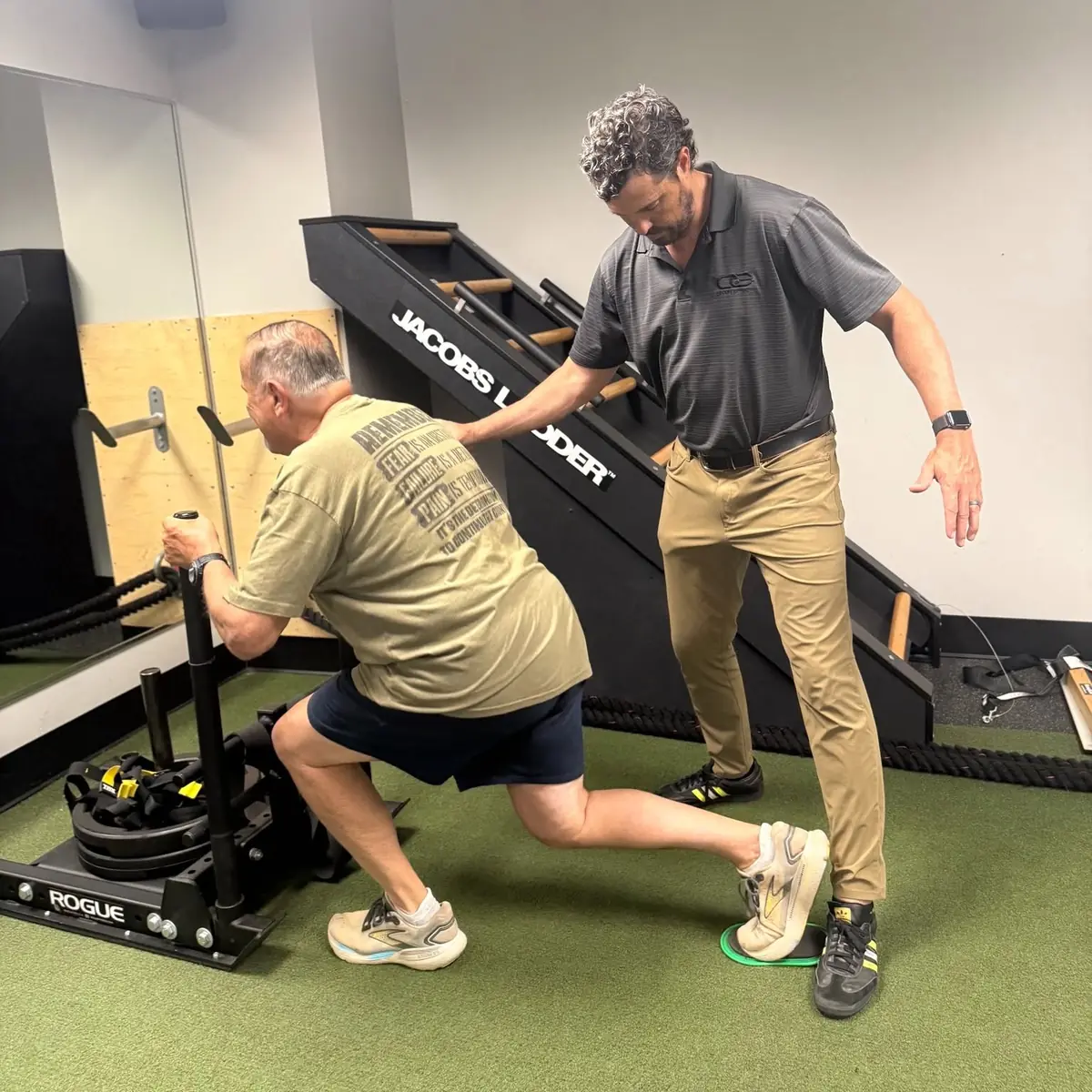
Treatment starts with a cause-first evaluation: testing how your knee, hip, and ankle move and load together, not just pressing on the spot that hurts, because where it hurts isn’t always why it hurts. From there, every visit is one-on-one with the same Doctor of Physical Therapy, blending hands-on treatment with strength work in our gym.
We stay with you until your goals are met, not until your benefits run out. There’s no early discharge: you decide when you’re ready.
Calm it down.
Hands-on manual therapy and positions that unload the irritated joint, starting the first visit. Most patients notice a meaningful difference within the first few sessions.
Restore what’s stuck.
Mobility work for the hip and ankle actually restricting your knee’s mechanics, dosed to what the knee can tolerate that week, not a printed sheet.
Build strength you trust.
Progressive quad, hamstring, and hip strength against standards you clear before moving on, so stairs, squats, and running become load-tolerant again, not just pain-free.
Make it stay fixed.
Testing before you’re cleared, including return-to-run or return-to-sport standards where they apply, then a home program sized to your actual week.
What does getting better look like?
People who end up booking an evaluation for knee pain are rarely the ones who blew it out in one dramatic play. More often, it’s a slower story: months of favoring stairs, skipping the run, deciding the knee is just what happens with age or mileage.
Most patients notice a difference within the first two or three visits, since hands-on treatment starts at the evaluation itself. From there, progress tends to show up in ordinary places first: stairs at a normal pace, kneeling without the negotiation, running the distance you used to without rationing it.
Left untreated, the cause behind knee pain rarely stays quiet; it tends to change how you walk and train, and each flare tends to run a little longer than the last.
An evaluation turns that guesswork into a plan with a specific estimate, reviewed with you as you progress.
Which services treat knee pain?
Physical Therapy
The foundation: 60-minute one-on-one sessions with a Doctor of Physical Therapy, hands-on from day one.
02Sports Rehab
Return-to-run and return-to-sport after a ligament sprain, meniscus irritation, or surgery.
03Dry Needling
Targets the quad, IT band, or hip guarding that builds up around an irritated knee.
04IASTM
Instrument-assisted work for patellar tendon and IT band tightness.
05Personal Training
Builds the quad and hip strength that keeps a healed knee from becoming a repeat visitor.
“I visit chain effect for physical therapy, nutrition, and personal training. Their practitioners are fantastic! Dyala is my trainer and she puts together challenging workouts and motivates me to do my best. I've been seeing Michael Hunt for physical therapy and he's is the most knowledgeable therapist I've been to. He had me up and running (literally) in two weeks after a therapist at a different practice had given up on me. Victoria is one of their nutritionists. What I really appreciate about her is that she completely customized a plan for my lifestyle and goals. There's no judgement and no wacky diets. Everything is science based. And she helped me lose over 20 pounds. I've been going to Chain Effect for over a year and can't recommend it enough!”Rachel Thiel · Google review
Questions, answered plainly.
The things people ask on the phone about their knee, written down.
Most knee pain isn’t a medical emergency, but “serious” isn’t something to guess at from home. Sometimes the ache fades while the cause stays, which is why it tends to return every time you run, kneel, or take the stairs, often lasting a little longer each round. An evaluation tells you what you’re actually dealing with, and if anything looks like it needs a physician first, we’ll say so and point you there directly.
In plain terms: runner’s knee usually involves irritation around the kneecap, a meniscus issue is the cartilage cushion catching or aching, and a ligament sprain is an overloaded or unstable ACL, MCL, or similar structure. They can overlap, which is why the evaluation tests movement, strength, and stability instead of guessing from one symptom.
Usually, yes, with modifications your doctor gives you at the evaluation. Most knee plans work around your training rather than pausing it entirely: mileage, incline, or certain lifts get adjusted for a while, then reintroduced as you’re ready. You’ll get specific guidance for your sport, not a blanket “rest” instruction.
Avoid pushing through a sharp or catching pain, deep loaded squats that reproduce the symptom, and sudden increases in running mileage or incline. Beyond that, avoidance is rarely the fix: most people do better learning which movements are safe and how to load them correctly than by sitting still and waiting. Your evaluation will tell you exactly what to modify and for how long.
Start with a cause-first evaluation for your knee.
Gameplan with an expert.
A few short questions. Our client matchmaker reaches out to learn about your pain, challenges, and goals, and connects you with the right expert.
If you’re in acute pain and want to be seen the next morning, tell us in your message and we’ll do our best to get you in as soon as possible.
Here we go.
Our client matchmaker will reach out as soon as possible. During business hours, Mon–Thu 8–5 and Fri 8–4, we strive to get in touch within 15 minutes.
Can’t wait? Call (919) 594-1885 ⟶Find us on Blue Ridge Road.
Rehab, training, and nutrition under one roof in Raleigh, with virtual nutrition counseling for clients anywhere.
The clinic · Chain Effect Physical Therapy
Get Directions ⟶Opens in Google Maps