

Raleigh, NC · What we treat
Hip pain in Raleigh.
A stiff, catching, or aching hip rarely announces its own cause: a cause-first evaluation finds out why, then a personalized plan gets you back to stairs, the car, and a full night’s sleep without doing the math first.
You’ve probably said one of these.
Nobody walks in describing labral irritation. They describe mornings like these. Tap one that sounds like your week.
-
UsuallyHip flexor strain, muscle at the front of the hip reacting to the flexion and rotation getting out of a car asks for.
Why does this happen ⟶ -
UsuallyHip bursitis or tendinopathy, irritated enough that side-sleeping aggravates whichever hip ends up on the mattress.
Why does this happen ⟶ -
UsuallyLabral irritation or joint wear, reacting to the deep hip flexion that tying a shoe requires.
Why does this happen ⟶
- “I take the escalator now instead of the stairs, and tell myself it’s about time.”
- “Getting up from the couch, I do this little shuffle before my hip agrees to move.”
- “I used to walk the whole store. Now I’m doing math about how far the car is.”
If two or three of those sound like your week, you’re not describing a mystery. You’re describing a pattern we see often, and one an evaluation is built to explain.
Why does hip pain happen?
There’s rarely one single cause, which is exactly why guessing doesn’t work. What we usually find, alone or in combination:
- Hip bursitis or tendinopathy. The fluid-filled cushion or tendons at the outside of the hip, irritated enough to ache with stairs, side-sleeping, or a long walk.
- Labral irritation. The cartilage rim around the hip socket getting pinched, often surfacing as a catch or pinch deep in the front of the hip with pivoting or a deep squat.
- Hip flexor strain. Muscles at the front of the hip overloaded by running, kicking sports, or a desk job that leaves the hip folded for eight hours a day.
- Joint wear. Gradual change in the hip joint’s cartilage, often showing up as stiffness first thing in the morning or after sitting a while.
- Referral from the lumbar spine or SI joint. Pain that actually starts at the spine or pelvis and refers into the hip, easy to mistake for a hip problem itself.
None of these are diagnoses you make yourself, and most don’t require imaging to start treating. That’s what the evaluation sorts out.
How do we treat hip pain in Raleigh?
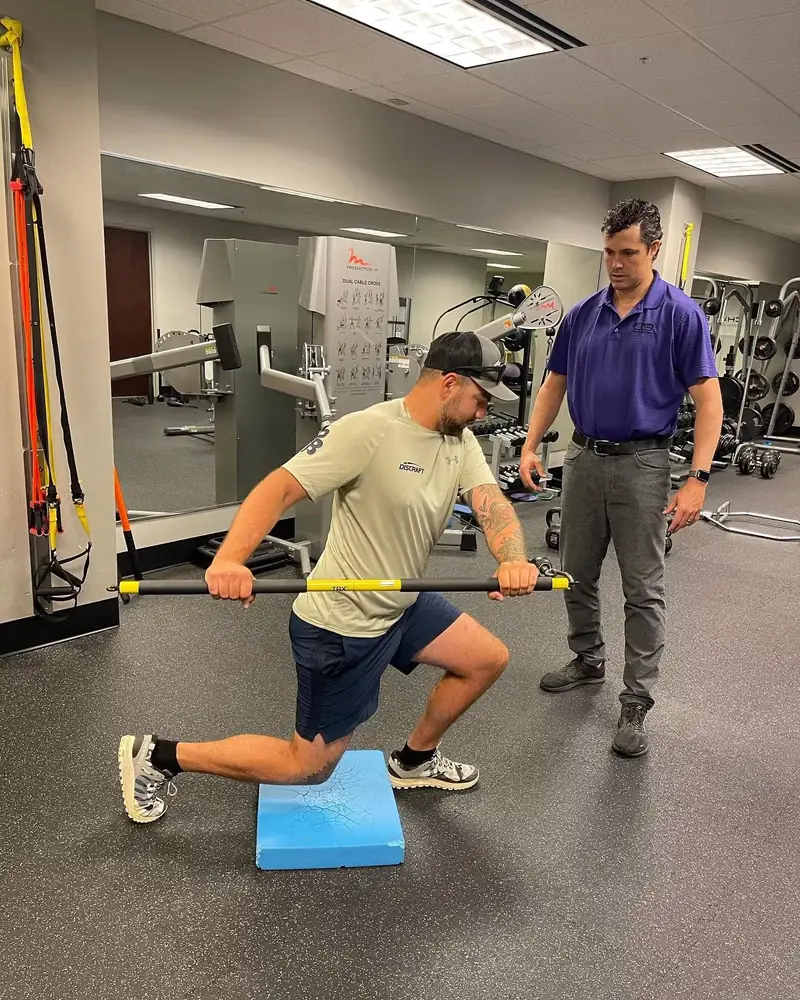
Treatment starts with a cause-first evaluation: testing how your hip, pelvis, and lumbar spine move and load together, not just pressing on the spot that hurts, because where it hurts isn’t always why it hurts. From there, every visit is one-on-one with the same Doctor of Physical Therapy, blending hands-on treatment with strength work in our gym.
We stay with you until your goals are met, not until your benefits run out. There’s no early discharge: you decide when you’re ready.
Calm it down.
Hands-on manual therapy and positions that unload the irritated tissue, starting the first visit. Most patients notice a meaningful difference within the first few sessions.
Restore what’s stuck.
Mobility work for the hip capsule and surrounding joints actually restricting you, dosed to what the hip can tolerate that week, not a printed sheet.
Build strength you trust.
Progressive hip and glute strength against standards you clear before moving on, so stairs, squats, and getting out of a low chair become load-tolerant again, not just pain-free.
Make it stay fixed.
Testing before you’re cleared, then a home program sized to your week, plus coaching on the habits that tend to reload the same spot.
What does getting better look like?
People who end up booking an evaluation for hip pain are rarely the ones who twisted it in a single bad step. More often, it’s a slower story: months of favoring one side, avoiding the low couch, deciding the limp is just part of getting older.
Most patients notice a difference within the first two or three visits, since hands-on treatment starts at the evaluation itself. From there, progress tends to show up in ordinary places first: getting out of the car without the pause, sleeping through the night on either side, walking the store without counting steps back to it.
Left untreated, the cause behind hip pain rarely stays quiet; it tends to change how you walk, sit, and sleep, and each flare tends to run a little longer than the last.
An evaluation turns that guesswork into a plan with a specific estimate, reviewed with you as you progress.
Which services treat hip pain?
Physical Therapy
The foundation: 60-minute one-on-one sessions with a Doctor of Physical Therapy, hands-on from day one.
02Sports Rehab
Return-to-run and return-to-sport work for athletes.
03Dry Needling
Targets the glutes and deep hip rotators.
04Active Release Technique
Soft tissue work for tight hip flexors and glutes.
05Personal Training
Builds the hip and glute strength that keeps a healed hip from becoming a repeat visitor.
“Taylor Pope and Taylor Garlington are the best physical therapists I have ever seen. They are worth every penny, whether you are an athlete, recovering from injury/surgery, or just want to improve your strength and mobility. I also recommend joining Chain Effect’s gym. You get 24/7 access plus a variety of recovery resources.”Kelly Dagger · Google review
Questions, answered plainly.
The things people ask on the phone about their hip, written down.
Most hip pain isn’t a medical emergency, but “serious” isn’t something to guess at from home. Sometimes the ache fades while the cause stays, which is why it tends to return every time you sit low, sleep on that side, or take a long walk, often lasting a little longer each round. An evaluation tells you what you’re actually dealing with, and if anything looks like it needs a physician first, we’ll say so and point you there directly.
In plain terms: bursitis usually involves an irritated cushion at the outside of the hip, a labral issue is irritation of the cartilage rim inside the joint, and a hip flexor strain is overloaded muscle at the front of the hip. They can overlap, which is why the evaluation tests movement, strength, and the joints around the hip instead of guessing from one symptom.
Usually, yes, with modifications your doctor gives you at the evaluation. Certain movements get adjusted or scaled back for a while, then reintroduced as you’re ready, not a blanket “rest” instruction.
Avoid pushing through a sharp or pinching pain, deep squats or pivots that reproduce the catch, and long stretches sitting low without moving. Beyond that, most people do better learning which movements are safe than by sitting still and waiting. Your evaluation will tell you exactly what to modify and for how long.
Start with a cause-first evaluation for your hip.
Gameplan with an expert.
A few short questions. Our client matchmaker reaches out to learn about your pain, challenges, and goals, and connects you with the right expert.
If you’re in acute pain and want to be seen the next morning, tell us in your message and we’ll do our best to get you in as soon as possible.
Here we go.
Our client matchmaker will reach out as soon as possible. During business hours, Mon–Thu 8–5 and Fri 8–4, we strive to get in touch within 15 minutes.
Can’t wait? Call (919) 594-1885 ⟶Find us on Blue Ridge Road.
Rehab, training, and nutrition under one roof in Raleigh, with virtual nutrition counseling for clients anywhere.
The clinic · Chain Effect Physical Therapy
Get Directions ⟶Opens in Google Maps