

Raleigh, NC · What we treat
Elbow and wrist pain in Raleigh.
A grip that gives out, or a forearm that’s stopped forgiving repetition: a cause-first evaluation finds why your elbow or wrist is doing this, then a personalized plan gets you gripping, typing, and lifting without the wince first.
Sound familiar?
Nobody walks in describing lateral epicondylalgia. They describe days like these.
-
UsuallyTennis elbow or a grip strength that’s backed off to protect an irritated tendon.
See how dry needling releases the forearm ⟶ -
OftenNerve irritation at the wrist, sometimes carpal tunnel, aggravated by a fixed position held too long.
See how physical therapy restores the position and the load ⟶ -
UsuallyTendon irritation right at the attachment point, the classic tennis-elbow spot, worse with direct pressure.
See how soft tissue work supports the tendon’s recovery ⟶
- “My grip gives out on the coffee mug about once a week now.”
- “I’ve switched to a two-handed handshake, angled so it doesn’t hurt.”
- “Wringing out a towel is the one chore I’ve quietly handed off.”
If two or three of those sound like your week, you’re not describing a mystery. You’re describing a pattern we see often, and one an evaluation is built to explain.
Why do elbow and wrist pain happen?
There’s rarely one single cause, which is exactly why guessing doesn’t work. What we usually find, alone or in combination:
- Tennis elbow. Irritation at the tendons on the outside of the elbow, often from repetitive gripping or wrist extension, racquet sport or otherwise.
- Golfer’s elbow. The same pattern on the inside of the elbow, often from repetitive gripping or wrist flexion under load.
- Carpal tunnel or wrist nerve irritation. Pressure on the nerve running through the wrist, often worsened by repetitive typing, gripping, or sleeping with the wrist bent.
- Wrist tendinopathy. Overloaded tendons crossing the wrist, often from repetitive lifting, typing, or a new activity the wrist wasn’t conditioned for.
- Desk and device strain. Hours of typing, scrolling, or gripping a steering wheel in a fixed position that compounds through the week.
None of these are diagnoses you make yourself, and most don’t require imaging to start treating. That’s what the evaluation sorts out.
How do we treat elbow and wrist pain in Raleigh?
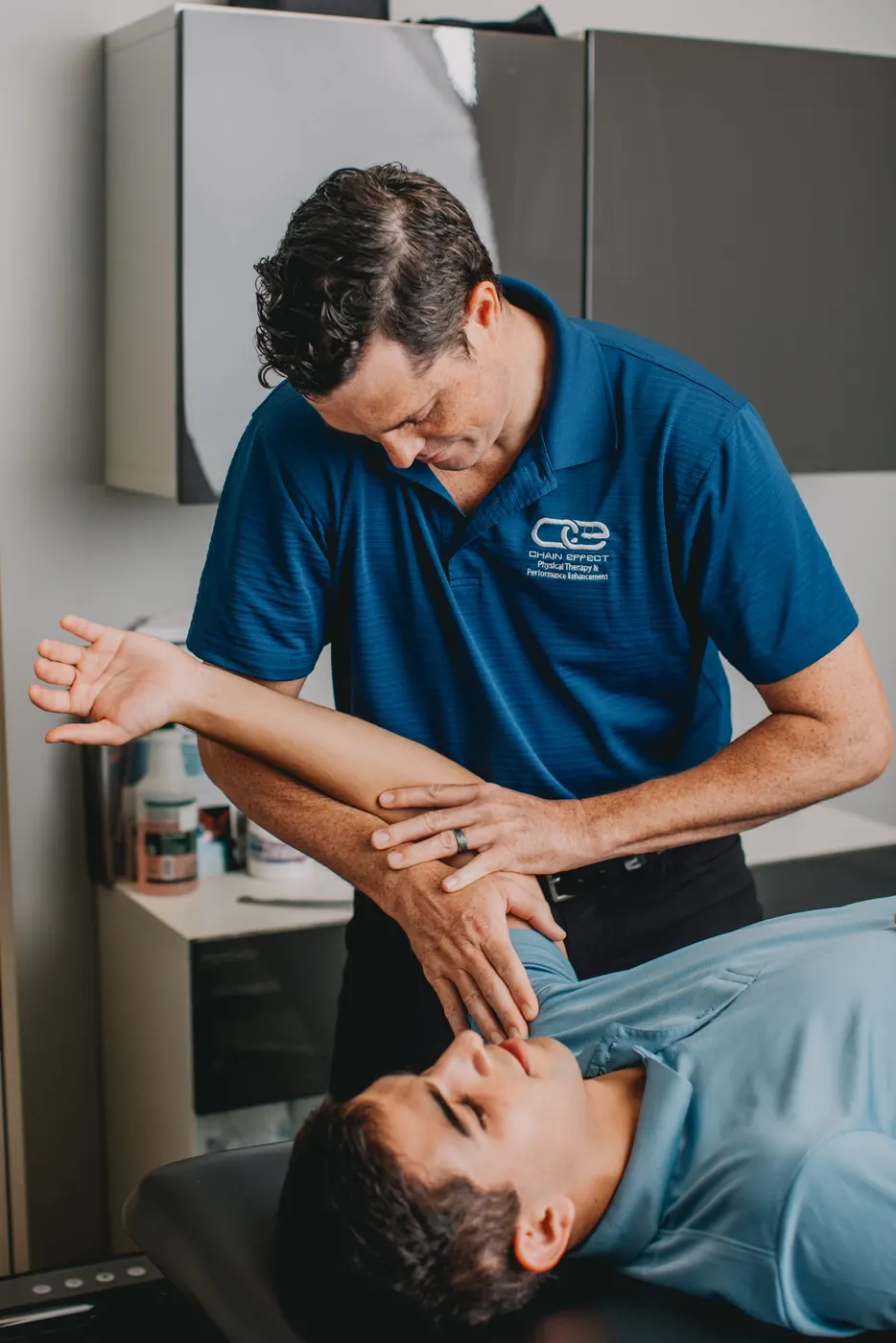
Treatment starts with a cause-first evaluation: testing how your wrist, forearm, elbow, and even your neck and shoulder load together, because grip trouble doesn’t always start at the grip. From there, every visit is one-on-one with the same Doctor of Physical Therapy, blending hands-on treatment with strength work in our gym.
We stay with you until your goals are met, not until your benefits run out. There’s no early discharge: you decide when you’re ready.
Calm it down.
Hands-on manual therapy and bracing or activity guidance that unload the irritated tendon, starting the first visit.
Restore what’s stuck.
Mobility work for the wrist and forearm actually restricting you, dosed to what the tissue can tolerate that week.
Build strength you trust.
Progressive grip and forearm strength against standards you clear before moving on, so gripping and lifting become load-tolerant again, not just pain-free.
Make it stay fixed.
Testing before you’re cleared, then a home program sized to your desk setup, sport, or job, plus coaching on the wrist position and grip habits that tend to reload the same tendon.
What does getting better look like?
People who end up booking an evaluation for elbow or wrist pain are rarely the ones who hurt it in one dramatic swing. More often, it’s a slower story: months of quietly asking for help with jars, avoiding the handshake, deciding a sore forearm is just what happens after forty. If that’s closer to your version, you’re the typical patient here, not an outlier.
Most patients notice a difference within the first two or three visits, since hands-on treatment starts at the evaluation itself. Progress tends to show up in ordinary places first: opening a jar without asking for help, typing past an hour without the buzz, gripping a coffee mug without a second thought.
Left untreated, the cause rarely stays quiet; it tends to change how you grip, type, and lift, and each flare tends to run a little longer than the last.
An evaluation turns that guesswork into a plan with a specific estimate, reviewed with you as you progress.
Which services treat elbow and wrist pain?
Physical Therapy
The foundation: 60-minute one-on-one sessions with a Doctor of Physical Therapy, hands-on from day one.
02Active Release Technique
Pressure-plus-movement soft tissue work for tennis and golfer’s elbow.
03IASTM
Instrument-assisted work for irritated forearm tendons.
04Dry Needling
Releases forearm trigger points that keep grip painful.
05Personal Training
Rebuilds grip and forearm strength for work, lifting, and sport.
“As a result of a wrist fracture I have been seeing a Michael a Physical Therapist to increase my range of motion and Victoria a nutritionist to increase calcium in my diet. They have both been very friendly, easy to work with, and helpful. The physical therapy is done in individual rooms and a large gym. There is also an app that Michael uploads exercises I can do at home or in the gym between appointments.The nutrition appointments are virtual and I do those from the comfort of my own home.I am happy with the progress they have helped me make.”Lisa Holzworth · Google review
Questions, answered plainly.
The things people ask on the phone about their elbow and wrist, written down.
It could be any of the three, and they can feel similar from the inside: tennis elbow usually sits on the outside of the elbow, golfer’s elbow on the inside, and carpal tunnel tends to show up as numbness or tingling in the hand along with wrist pain. The evaluation tests grip, movement, and nerve provocation to sort out which pattern, or combination, fits what you’re dealing with.
Usually not, though certain positions and loads typically get modified for a while. Most plans work around your job and training rather than pausing them entirely: grip-heavy or repetitive movements get scaled back and reintroduced once you’ve cleared the standard. Guidance is specific to your desk setup or sport, not a blanket rest instruction.
A brace can ease symptoms temporarily by taking load off the irritated tendon or nerve, but it rarely addresses why the tissue got overloaded in the first place. Most people who rely on a brace alone find the pain returns once they take it off and go back to the same grip pattern. An evaluation identifies the cause, so the brace supports the plan instead of replacing it.
Avoid pushing through a sharp pain with gripping or twisting, repetitive motions held too long without a break, and sudden heavy lifting before you’ve been cleared. Beyond that, avoidance is rarely the fix: most people do better learning which grips are safe to load than by resting completely and waiting. Your evaluation will tell you exactly what to modify.
Start with a cause-first evaluation for your elbow and wrist.
Gameplan with an expert.
A few short questions. Our client matchmaker reaches out to learn about your pain, challenges, and goals, and connects you with the right expert.
If you’re in acute pain and want to be seen the next morning, tell us in your message and we’ll do our best to get you in as soon as possible.
Here we go.
Our client matchmaker will reach out as soon as possible. During business hours, Mon–Thu 8–5 and Fri 8–4, we strive to get in touch within 15 minutes.
Can’t wait? Call (919) 594-1885 ⟶Find us on Blue Ridge Road.
Rehab, training, and nutrition under one roof in Raleigh, with virtual nutrition counseling for clients anywhere.
The clinic · Chain Effect Physical Therapy
Get Directions ⟶Opens in Google Maps